
Home » Our Pipeline » ANB033 » Celiac Disease

Moving upstream to address the root of Celiac disease pathology

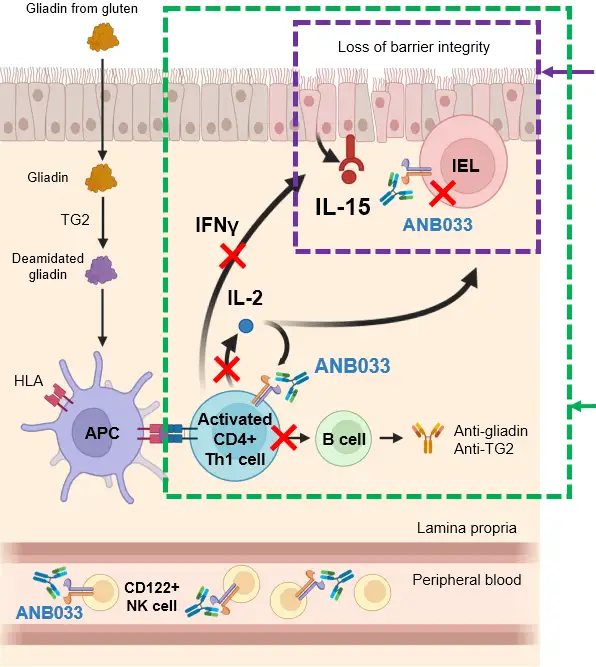
ANB033 targets CD122 to block the IL‑15 and IL‑2 signals that drive the pathogenic immune cells responsible for intestinal damage in celiac disease.

Celiac disease is a serious autoimmune condition in which gluten ingestion triggers immune‑mediated damage to the small intestine.

  • Celiac affects an estimated 1 in 100 people worldwide, yet only about 30% are properly diagnosed
  • Celiac disease can develop at any age after gluten exposure, and without treatment, it can lead to significant long‑term health complications

1 in 100

people affected worldwide

~30%

properly diagnosed

Why targeting CD122 is a promising approach

Celiac disease is marked by a dense infiltration of inflammatory CD122+ immune cells, including:

  • CD8+ and CD4+ T cells producing IFNγ
  • NK cells producing IFNγ and granzyme B
  • IELs (intraepithelial lymphocytes), many of which are CD122+

CD122+ cells increased 50–150% compared to healthy tissue. In addition, epithelial cells, myeloid cells, and lymphocytes broadly expressed IL‑15, fueling persistent inflammation.

CD122+ cells increased

50–150%

compared to healthy tissue

Why ANB033's mechanism fits Celiac disease biology

Excessive IL‑15 and IL‑2 signaling drives pathogenic immune activation in celiac disease. ANB033 blocks CD122, the shared receptor subunit for both cytokines, enabling upstream modulation of disease-driving cells.

graphic related to Celiac disease

Select the beacons to learn more

Inhibition of IL-2 signaling

IL-2 stimulates

  • CD4 effector memory T cell activation and proliferation
  • IFNγ production leading to IL-15 secretion

Inhibiting IL-2 signaling reduces

  • Gluten-responsive CD4 T cell expansion
  • Inflammatory cytokine secretion
  • Downstream B cell-mediated antibody responses

Inhibition of IL-15 signaling

  • IL-15 induces proliferation of IELs
  • Majority of IELs are CD122+ T cells
  • Inhibiting IL-15 signaling reduces IELs
  • Decreases epithelial cell destruction
  • Helps restore barrier integrity
For the latest on the status of our clinical development
Scientific presentations & publications on ANB033